The Four Sisters
The Four Sisters
Every July we run a regatta called the Four Sisters Open. Several hundred young sailors come, most of them teenagers, and the great majority were born after the four sisters came down. If you have raced here, crewed here, or stood at the top of the ramp holding somebody's dry clothes, this is the story behind the name on the entry form.
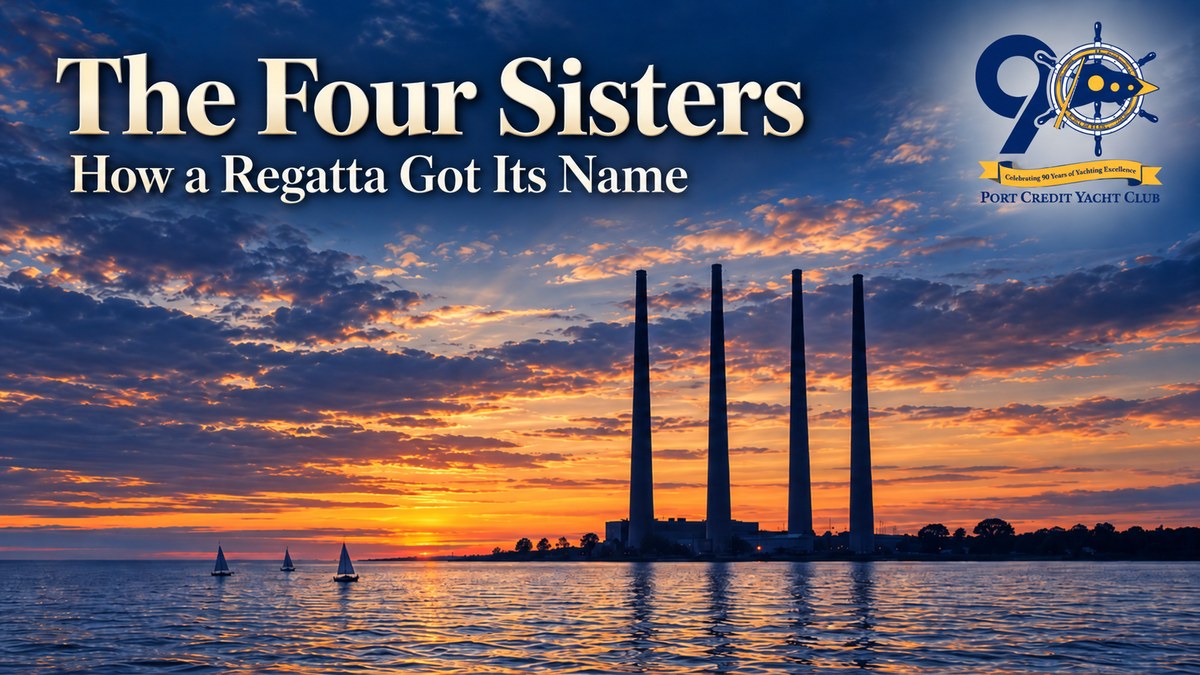
They stood barely a kilometre from our gate, on Lakeshore Road just past Cawthra: four concrete smokestacks at the Lakeview Generating Station, each close to 150 metres tall. For more than forty years they were the tallest things on this stretch of the lake, and for anyone sailing home to Port Credit they were the first thing you picked up on the horizon.
Four Marks on the Horizon
There were four of them because the station ran eight boilers and twinned the exhaust, two boilers to a stack. The same arrangement had been used on the four-funnel liners that crossed the Atlantic, which is a pleasing thing to know about a power station.
Sailors used them constantly. A landmark that tall beats any amount of chart work, and the sisters could be seen from Burlington in the west and from downtown Toronto in the east. Fishing boats, cruisers, racing crews and aircraft all took their bearings from them. If you could see the sisters, you knew roughly where you were and roughly how long you had left to sail.
They did the job a lighthouse does, by accident, for forty-odd years, and they did it for free. Generations of local sailors learned this piece of water with those four shapes standing over their shoulder.
What Lakeview Was
The station came online in 1961 and grew through the sixties until it ran eight generating units. At its peak it supplied roughly seventeen per cent of Ontario's electricity, which made it one of the most important pieces of infrastructure in the province and by some distance the largest thing on our shoreline. It ran for forty-three years and closed on the last day of April in 2005.
We should be straight about what it was, too. Lakeview burned coal, a great deal of it, and the air over this part of the lake was the worse for it. The province closed it for sound reasons and our shoreline is healthier for the change. Sailors can hold both ideas at once. The sisters were a blight and a beacon, they fouled the air and they told you where home was, and most landmarks people grow attached to turn out to be complicated in roughly that way.
The Morning They Came Down
On June 12, 2006, at half past seven in the morning, Murray Demolition brought them down. The charges fired from east to west, one stack toppling every four seconds, all four falling to the east. Hundreds of people gathered in a park nearby to watch, and helicopters circled overhead filming it.
Mississauga's mayor, Hazel McCallion, was among those standing in that park. Speaking to CBC that morning, she said the stacks had been "a landmark for sailors, for boaters, especially for the fishing boats." She had the order of it right: the city lost a silhouette, and the people on the water lost a mark they had steered by their whole lives.
The whole sequence was over in well under a minute. The horizon that generations of Mississauga sailors had used simply became sky. The rest of the building followed a year later, and the land has been quiet since, waiting on a new neighbourhood and the parkland going in along the shore.
Named While They Still Stood
Our regatta grew out of the Millennium Regatta, first sailed here in 2000. The Club wanted a major mid-summer dinghy event, and the name came from the landmark every sailor on this water already used.
Which means we named it while the sisters were still standing, and we have carried the name for twenty years since they fell. The regatta outlived the thing it was named after. This July we ran the twenty-fifth Four Sisters Open, on the eighteenth and nineteenth, straight after the sixty-seventh Steerers' Invitational, as part of the busiest stretch in our racing year.
There is something quietly right about that. Sailing clubs are full of trophies named for people the prize-giving forgot decades ago, and races named for boats that stopped floating long before anyone now sailing them was born. A name is one of the ways a place keeps hold of what it used to be.
SEE THE FOUR SISTERS OPEN
Race details, history and registration for one of the cornerstones of our youth sailing calendar. pcyc.net/four-sisters
The Other Four Sisters
We give the name a second meaning, and it is the better one.
Alongside the smokestacks, the Four Sisters honours the mothers and aunts who quietly shape and protect their families. Anyone who has spent a weekend at a junior regatta knows exactly who is meant. They are the ones in the folding chairs at the top of the ramp, holding somebody's dry clothes, feeding somebody else's crew, keeping the whole enterprise upright while the results sheet records somebody else entirely.
A regatta for young sailors named partly for the women who get them there is a good piece of thinking, and it has aged better than the smokestacks did. The stacks lasted a little over four decades. That second meaning looks likely to outlast all of us.
What a Name Holds Onto
A club that runs long enough accumulates a great deal of this. Our Steerers' Trophy is crafted from a wooden Nutshell rudder. The Susan Hood Trophy Race carries the name of Doug Hood's daughter, because Doug donated the trophy in her honour and the race has run since 1955. And the Four Sisters is named for four smokestacks and for the women who packed the lunches.
A tidy branding exercise would strip every one of them out, and every one of them is the reason this place feels like somewhere rather than anywhere.
If you remember steering by the sisters, we would like to hear about it. A good many people here learned this lake with those four shapes on the horizon, and those memories belong in the Club's record while the people who hold them are still around to tell it.
TELL US WHAT YOU REMEMBER
Send us your memory of the sisters, on the water or from the shore, and we will add it to the Club's history. info@pcyc.net
The sisters are gone from our skyline. They are still on our calendar every July.
START A YOUNG SAILOR
Our youth programmes, from a first day in a dinghy through to the racing squad. pcyc.net/youth-learn-to-sail